
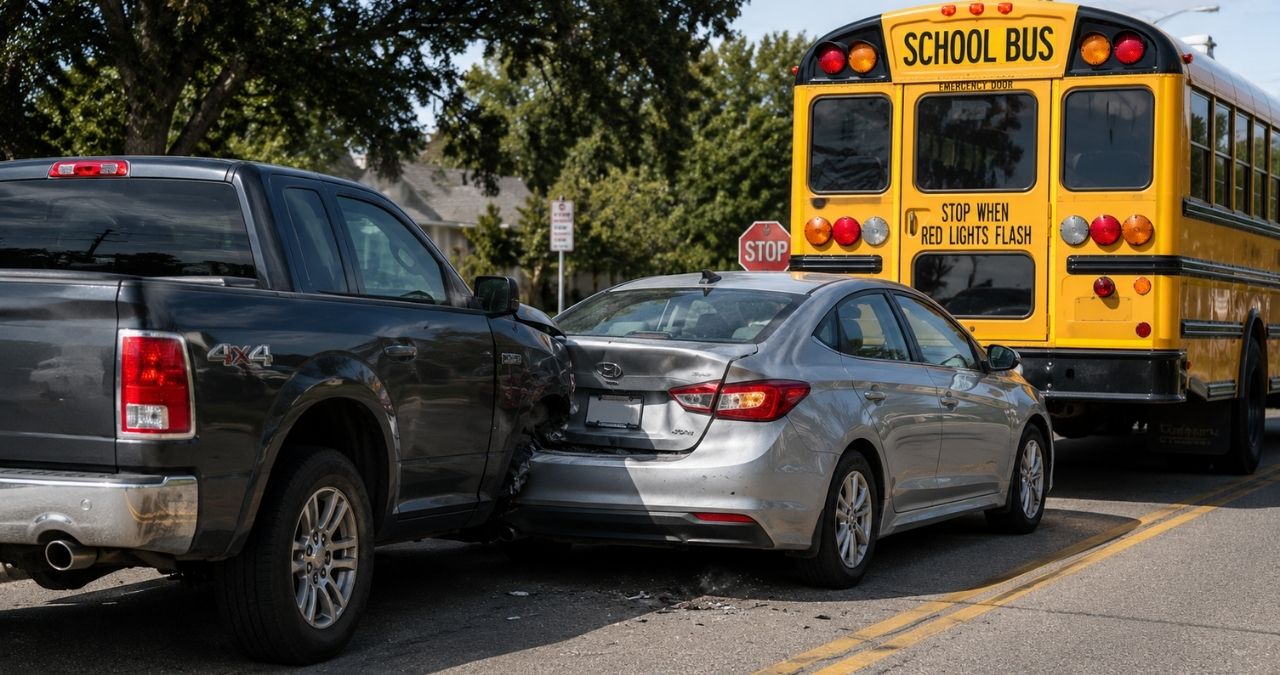
A driver stops for a school bus on Dodge Street near 72nd in Omaha. The pickup behind him never brakes. The impact costs him a cervical fusion, eleven weeks off work, and $180,000 in medical bills and lost wages. Six months later the pickup driver’s insurance adjuster calls with an offer of $72,000. The adjuster explains the discount: a witness told the responding officer that the sedan’s brake lights looked dim, so the carrier has assigned the injured driver 60 percent of the fault. Under Nebraska comparative negligence rules, the adjuster says, that ends the claim.
The adjuster is describing a real rule and applying it wrong. Nebraska does reduce an injury award by the injured person’s share of fault, and Nebraska does cut off recovery entirely at a threshold. Neither the percentage nor the cutoff is something an insurance company gets to decide. This post explains how fault allocation actually works in Nebraska personal injury cases, what the 50 percent bar means in dollars, who assigns the percentage, and how injured people in Omaha push back when a carrier inflates their share.
What Is Nebraska’s Comparative Negligence Rule?
Nebraska follows modified comparative negligence. The governing statute, Neb. Rev. Stat. sec. 25-21,185.09, provides that any contributory negligence chargeable to the claimant “shall diminish proportionately the amount awarded as damages for an injury attributable to the claimant’s contributory negligence but shall not bar recovery, except that if the contributory negligence of the claimant is equal to or greater than the total negligence of all persons against whom recovery is sought, the claimant shall be totally barred from recovery.”
Two rules live inside that sentence.
The first is proportional reduction. Being partly at fault shrinks a Nebraska injury claim by the percentage of fault assigned, and the claim survives.
The second is the bar. Cross the 50 percent line and recovery drops to zero. A claimant found 49 percent at fault recovers 51 percent of the damages. At 50 percent, the same claimant recovers nothing.
Nebraska adopted this framework in 1992 through LB 262. Before then the state used a “slight versus gross” formulation that allowed recovery only where the plaintiff’s negligence was slight and the defendant’s was gross by comparison. For any claim that accrued after February 8, 1992, that old language is gone, and the Nebraska Supreme Court has held it is reversible error to instruct a jury under it. See Wheeler v. Bagley, 254 Neb. 232, 575 N.W.2d 616 (1998).
How Much Does Fault Actually Reduce a Nebraska Injury Award?
Percentages sound abstract until they meet a damages figure. Take the Omaha driver above, with $180,000 in provable damages.
Ten percent fault leaves him $162,000. A quarter of the blame drops the recovery to $135,000. Forty percent yields $108,000. Push him to 49 percent and he takes home $91,800. One more point erases the entire award.
That last point on the scale is worth $91,800. It explains why fault allocation is the most heavily litigated issue in many Nebraska injury cases, and why an adjuster’s opening position so often lands at exactly 50 or 60 percent. Convincing an injured person he is half at fault eliminates the carrier’s exposure outright.
One detail in the statute matters enormously and gets missed constantly. The claimant’s negligence is measured against “the total negligence of all persons against whom recovery is sought,” rather than against any single defendant. Where three defendants share responsibility, a plaintiff who is 40 percent at fault still recovers, because 40 is less than the defendants’ combined 60. Naming every responsible party in an Omaha suit therefore changes the math on the bar itself, and it does so before any question of collection arises.
Who Decides the Percentage of Fault?
Insurance adjusters assign fault percentages every day. None of those numbers carries legal force. In a Nebraska case that goes to trial, the jury allocates negligence, and the trial judge must formally instruct the jury on the consequences of that allocation.
The Nebraska Supreme Court has enforced that instruction requirement without flexibility. Omitting an instruction on the effects of the allocation of negligence is prejudicial error. Pleiss v. Barnes, 260 Neb. 770, 619 N.W.2d 825 (2000). A verdict form that asks the jury for percentages does not substitute for a proper instruction. Russell v. Stricker, 262 Neb. 853, 635 N.W.2d 734 (2001). Failing to give the instruction at all can rise to plain error even absent an objection. Fiscel v. Beach, 254 Neb. 678, 578 N.W.2d 52 (1998). The Legislature intended jurors to understand exactly what their numbers do before they write them down.
Trial courts also cannot take the question away from the jury whenever the evidence supports competing readings. Where the evidence permits reasonable minds to draw different conclusions about apportionment, the allocation of fault belongs to the jury rather than to the court as a matter of law. Traphagan v. Mid-America Traffic Marking, 251 Neb. 143, 555 N.W.2d 778 (1996).
That rule is the injured person’s leverage. An adjuster asserting 60 percent fault on a contested record is asserting something a Douglas County judge would refuse to decide on summary judgment. The number is an opening bid.
How Is Fault Divided Among Multiple Defendants?
Nebraska splits liability differently depending on the type of damages. Under Neb. Rev. Stat. sec. 25-21,185.10, defendants in a multi-defendant negligence case are jointly and severally liable for economic damages, meaning medical bills, lost wages, and other out-of-pocket loss. Any one of them can be pursued for the full economic award.
Noneconomic damages work differently. Each defendant is liable only for the portion of noneconomic damages allocated to that defendant in direct proportion to that defendant’s percentage of negligence. A defendant found 20 percent responsible pays 20 percent of the pain and suffering award and no more.
An exception restores full joint and several liability across both categories. Defendants who act in concert as part of a common plan or design remain jointly and severally liable for the entire award. Nebraska courts have read the joint-enterprise trigger to require a shared pecuniary interest, not merely parallel conduct.
The statute also has a threshold that surprises people. It operates only where more than one defendant remains in the case at trial. When settlements narrow the case to a single defendant, the allocation scheme drops out. Settlement sequencing in a multi-defendant Omaha case therefore carries consequences well beyond the settlement dollars.
Is Assumption of Risk the Same as Comparative Negligence?
No. Nebraska treats assumption of risk as a separate affirmative defense with its own elements, codified at Neb. Rev. Stat. sec. 25-21,185.12. A defendant asserting it must prove that the injured person knew of the specific danger, understood that danger, and voluntarily exposed himself or herself to it. Injury resulting from that exposure completes the defense.
Each element is demanding. Generalized awareness that an activity carries some risk does not establish knowledge of the specific danger. Exposure under economic pressure, employer instruction, or emergency conditions is frequently not voluntary. The defense succeeds far less often than defense letters suggest, and it does not overlap cleanly with the percentage allocation of negligence under section 25-21,185.09.
Strict liability claims sit outside the comparative framework altogether. Comparative negligence principles do not apply to strict liability in tort. Shipler v. General Motors Corp., 271 Neb. 194, 710 N.W.2d 807 (2006). A defective product case proceeds on different terrain than an ordinary negligence case, and a defendant who tries to import fault percentages into it is arguing against controlling Nebraska authority.
How Do Carriers Inflate an Injured Person’s Share of Fault?
Patterns repeat across Nebraska claims files.
Speed is the usual lever. Traveling three miles per hour over a posted limit becomes, in an adjuster’s summary, the proximate cause of a rear-end collision the injured driver could not have avoided at any speed.
Medical history supplies the second lever. Degenerative changes visible on an MRI are recast as proof that the claimant’s own body, rather than the collision, produced the surgical indication.
Then there are recorded statements. A polite “I suppose I could have been watching more closely,” spoken to an adjuster three days after a wreck, reappears eighteen months later as an admission of comparative fault.
Carriers lean hardest on the police report. An officer’s contributing-factors checkbox adjudicates nothing, is frequently marked without any witness interview, and is generally inadmissible hearsay in a Nebraska civil trial.
Nothing on that list survives contact with real evidence. Event data recorder downloads establish actual speed and braking. Treating physicians distinguish preexisting degeneration from acute traumatic injury. Independent witnesses contradict a defendant driver’s account. Accident reconstruction quantifies whether an alleged plaintiff error had any causal effect at all. Each item moves the percentage, and every point of movement is worth money right up to the moment it clears the bar and becomes worth everything.
How Long Do You Have to File in Nebraska?
Four years. Neb. Rev. Stat. sec. 25-207 gives a four-year limitations period for an action for injury to the rights of the plaintiff not arising on contract. The clock runs from the date the damage occurs. Shorter deadlines apply to claims against political subdivisions and the State of Nebraska, and those notice requirements can expire within a year. Evidence that rebuts an inflated fault percentage, particularly vehicle data and surveillance footage, disappears long before either deadline.
Frequently Asked Questions
Can I recover anything in Nebraska if I was partly at fault for my accident?
Yes, provided your share of fault is less than the combined fault of everyone you are seeking recovery from. Your award is reduced by your percentage. At 30 percent fault on a $100,000 claim, you recover $70,000. At 50 percent or more, Neb. Rev. Stat. sec. 25-21,185.09 bars recovery completely.
Does the insurance adjuster’s fault percentage bind me?
It does not. Adjusters assign percentages to value claims and set reserves. Only a jury allocates negligence in a contested Nebraska case, and the trial court must instruct that jury on what its allocation means. An adjuster’s number is a negotiating position, and a documented record frequently moves it.
What happens if the jury finds me exactly 50 percent at fault?
You recover nothing. The statute bars recovery where the claimant’s negligence is equal to or greater than the total negligence of all persons against whom recovery is sought. Fifty percent functions as a cliff edge, and equal fault falls on the wrong side of it.
If two drivers hurt me, is my fault compared against each one separately?
No. Your negligence is compared against the total negligence of all persons from whom you seek recovery. Two defendants at 30 percent each total 60 percent, so a claimant at 40 percent still recovers 60 percent of the damages. Identifying every responsible party changes whether the bar applies.
Should I give a recorded statement to the other driver’s insurance company?
Speak with a lawyer first. Recorded statements are taken to develop comparative fault, and casual concessions made before the medical picture is complete get quoted back years later. You have no obligation to give one to the opposing carrier.
Talk to an Omaha Personal Injury Lawyer
If an insurance company has assigned you a share of fault that does not match what happened, the percentage is contestable and the dollars attached to it are substantial. Horgan Law LLC handles personal injury and complex litigation matters throughout Nebraska, and we try fault allocation as the damages issue it is. Contact us at 402-965-0652 or visit horganlawfirm.com/contact-us.
This article discusses general principles of Nebraska law and does not constitute legal advice or create an attorney-client relationship. Every case turns on its own facts.
If you were hurt in a crash, see our Omaha car accident attorney page or call 402-965-0652.